Project Hail Mary Review: Ryan Gosling’s Cosmic Buddy Film is a Total Winner
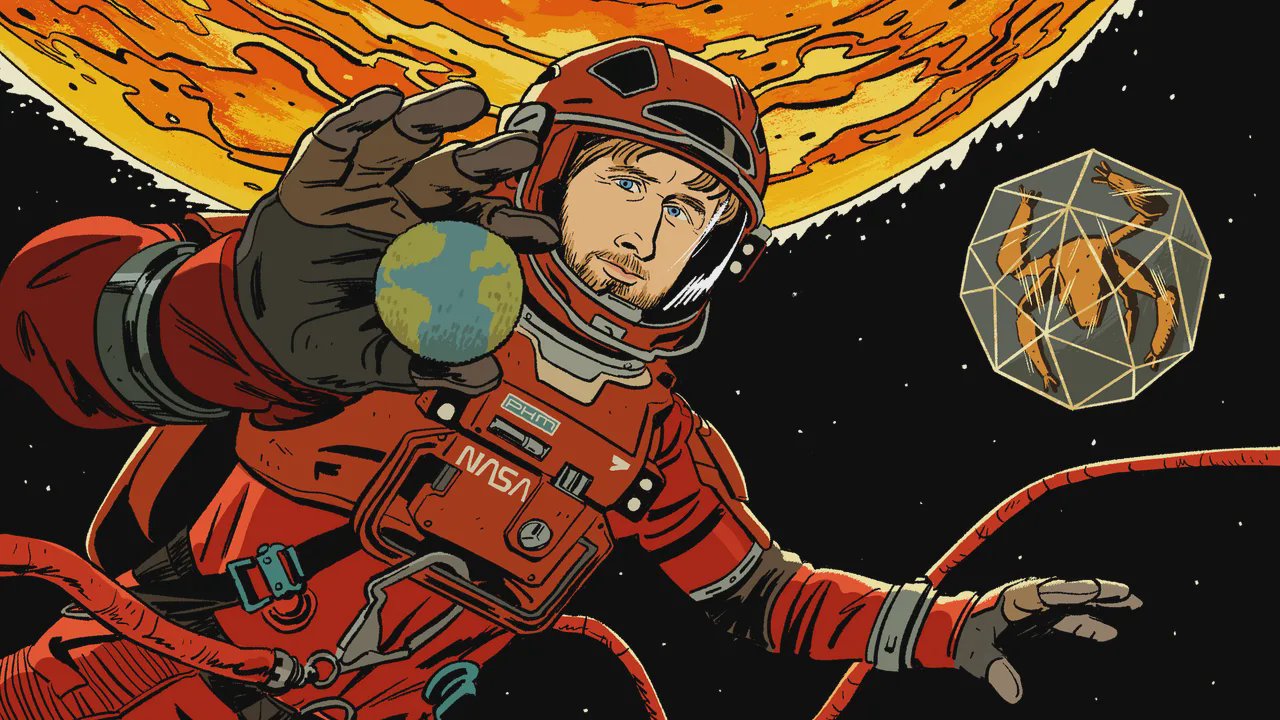
Look, let's be honest. When you walk into a two-hour-thirty-six-minute sci-fi spectacle that cost over $200 million to make, you have a fair idea of what to expect. You're prepared for the dazzling VFX, the larger-than-life IMAX visuals, and that classic feeling of being alone in the vastness of space. We've seen it all before—from Gravity to Interstellar, space is usually shown as a cold, silent place.
What you don't expect is to leave the theatre wanting to invent a whole new high-five language just to celebrate with your friends. You don't expect to absolutely fall in love with a five-legged, rock-like alien who communicates through musical notes. But believe it or not, here we are. Project Hail Mary, the latest film from the brilliant minds of Phil Lord and Christopher Miller (The Lego Movie, Spider-Verse), is so much more than just another survival story. It's the year's most unexpected and charming buddy comedy.
Releasing in India on March 20, the movie stars Ryan Gosling as Ryland Grace, a high school science teacher who wakes up from a coma on a spaceship, millions of miles away from Earth. He's confused, dishevelled, and has absolutely no memory of how he got there or why his two crewmates are no more. As his memory slowly returns through cleverly placed flashbacks, we learn the terrifying reality: the Sun is dying. A mysterious alien microbe is causing it to lose power, and Grace—a brilliant but academically sidelined molecular biologist—is humanity's final, desperate gamble. He is the Hail Mary pass.
The Gosling Effect: Bringing the 'Fun' to Astronaut
If you watched the Barbie movie, you already know Gosling has comedy timing in spades. He goes all in with that here. One moment he's calculating complex equations to save the world, the next he's panicking and claiming he put the "fun" in "dysfunctional astronaut" in a scene that feels delightfully improvised (apparently, it largely was). The directors let Gosling simply be Gosling—that slightly awkward, self-deprecating charm masking a sharp, lonely mind. Lord and Miller wanted to make a film not about how cold space is, but about a guy who feels lonely on Earth and travels to space just to find a friend. This idea works brilliantly because of Gosling. He makes isolation feel familiar, and his scientific discoveries feel like genuine victories.
Opposite him, we have Sandra Hüller (Anatomy of a Fall), playing the firm, no-nonsense task force leader Eva Stratt. Hüller brings a fascinating depth to a character who is essentially a tough bureaucrat, making difficult decisions without hesitation but never letting us forget there's a human being behind that steely exterior. Their scenes together in the flashbacks ground the massive space stakes in very real, earthly challenges.
Enter Rocky: The Real Star of the Show
But let's talk about the real hero here. About halfway through, Grace realises he's not alone. Another ship, from a planet called Erid, is on the same mission. Its only occupant is a creature Grace names "Rocky." And this is where Lord and Miller work their magic. Instead of a typical CGI creation, Rocky is a practical puppet, brought to life by performer James Ortiz. He has five arms, a body that resembles a friendly chunk of rock, and he communicates using musical tones that Grace's computer translates into simple, basic phrases.
And trust me, you will absolutely adore this alien. The bond between Grace and Rocky is the soul of the movie. They are two scientists from completely different worlds who can't even be in the same room together (atmospheric issues, you see), yet they develop a connection built on shared curiosity and pure, desperate hope. The scenes where Rocky "sings" his thoughts, or learns to bump fists with Grace, are genuinely heartwarming. It's the kind of cinema that reminds you why you love movies.
A Visual Treat Without the Green Screen Blues
Now, a quick note on how the film looks. You might have seen some online chatter—there was a bit of confusion when the directors mentioned there was "no green screen." They've since clarified things, and rightly so. There are thousands of VFX shots (courtesy of ILM and Framestore), but the key point is that they actually built the Hail Mary spaceship. For real. The sets are physical. Rocky was right there on set. This means the lighting is natural, the reflections in Gosling's helmet are real, and the actors are reacting to something tangible. The result is a film that feels solid and immersive, a universe you could almost reach out and touch. It's a refreshing change from the polished, overly digital look of many modern blockbusters.
The scale is enormous, but the story stays intimate and personal. It's essentially a two-character story between a guy and his new alien dost, trying to save their respective worlds. If you're a fan of Andy Weir's novel (and honestly, who isn't?), this adaptation is a streamlined success. Screenwriter Drew Goddard (who also adapted The Martian) knows exactly what to keep and what to let go, focusing squarely on the emotional heart rather than getting lost in complex scientific details.
For those who enjoy their sci-fi with a bit more... well, everything, this is the one. It hits the same sweet spot as the optimistic, problem-solving vibe of the Bobiverse books—you know, the We Are Legion (We Are Bob) series by Dennis E. Taylor, where a sentient AI has to figure out how to replicate and explore the galaxy. And if the tension of a classic space race is more your thing, Chris Hadfield's The Apollo Murders offers a grittier, thriller-style contrast to Hail Mary's warmth. But for pure, uplifting entertainment? This film is in a league of its own.
Why You Need to Catch This on the Big Screen
This isn't a film to wait for on OTT. It absolutely demands to be seen on the biggest, loudest screen you can find. The directors have created something that feels both timeless and completely fresh. It has the wonder of but the warmth of E.T..
- The Sound Design: Daniel Pemberton's score is beautiful and sweeping, but the sound of Rocky's ship, the vibrations of his language... it's simply incredible.
- Greig Fraser's Cinematography: The man who shot Dune knows how to make space feel massive, and he makes the intimate moments between Grace and his computer (voiced by Priya Kansara) feel just as epic.
- The Practical Effects: That ship. That alien. You have to see them in action.
Honestly, I walked in expecting a fun time. I walked out completely blown away. Project Hail Mary is a reminder that blockbusters can be smart, funny, and genuinely touching. It's a film about the power of working together, the beauty of scientific discovery, and the fact that even when the Sun is dying, you can still find a companion to help you through it. Amaze amaze amaze, for sure.