Cirielli's Meeting with Russian Ambassador Sparks Political Firestorm: What's Brewing Beneath the Surface?
Rome, a diplomatic hot potato that risks scalding the government majority. Deputy Foreign Minister Edmondo Cirielli meets with the Russian ambassador, and within hours, the government finds itself in the crosshairs of much of the opposition (and beyond). It's not the first time the name Cirielli has made headlines, but this time the controversy has taken on the proportions of a national affair, with repercussions reaching far beyond the halls of power.
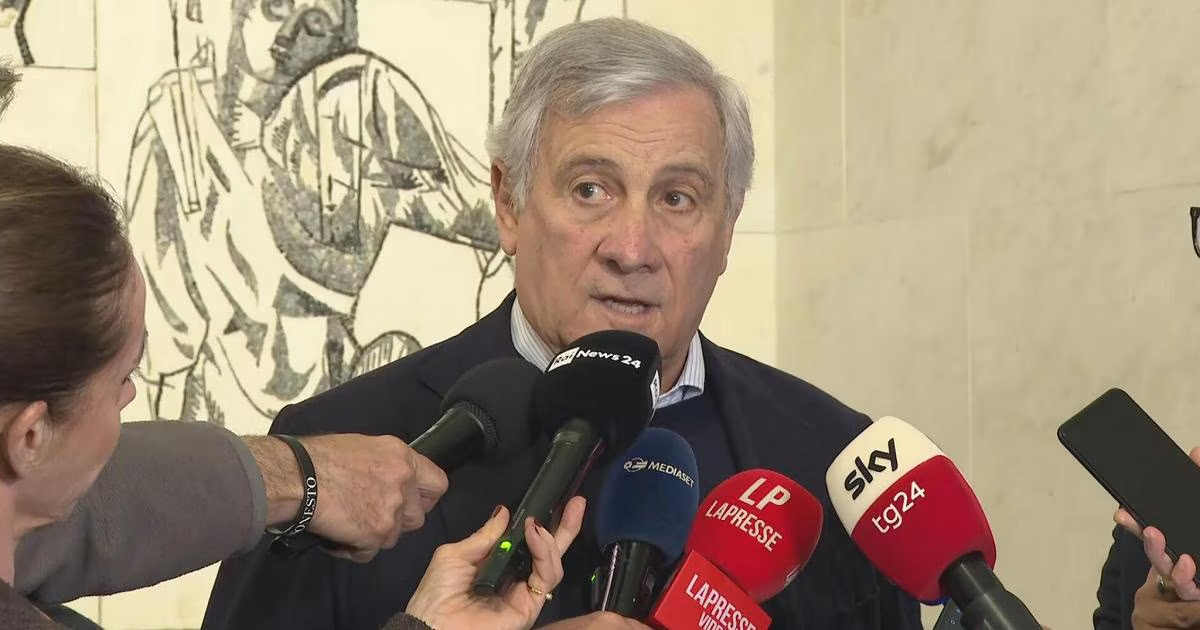
A Face-to-Face That Feels Like a Challenge to Europe
Diplomacy requires keeping channels of communication open with everyone, that's a given. But when Deputy Minister Cirielli sits down with the Kremlin's representative at a time when Brussels is keeping Russia at arm's length, the tune changes. The meeting, which took place at the Farnesina (the Italian Foreign Ministry), was widely interpreted as an attempt to thaw bilateral relations, swimming against the current of the EU's common line. And that's when the uproar began. There's a buzz in political circles: many are wondering whether this was a solo move or if it had Tajani's green light.
The first to react was the secretary of the Democratic Party, Elly Schlein, who launched an unequivocal attack: "If the government reopens channels with Russia, it distances itself from Europe." Strong words, echoing fears of a rift within the Western alliance. But the surprises don't end there.
A Bipartisan Chorus of Criticism
It's not just the centre-left turning up its nose. Jabs are also coming from the opposite side. Matteo Renzi, with his characteristic verve, doubled down, addressing Foreign Minister Antonio Tajani directly: "Someone tell Tajani to wake up." A clear message: Cirielli's move risks isolating Italy within the European context, precisely as Brussels tries to maintain a united front on the Ukrainian crisis.
- Elly Schlein (PD): "Reopening channels with Moscow means turning your back on the EU."
- Matteo Renzi (Italia Viva): "The government needs to wake up; you can't just go with the flow regarding Moscow."
- Antonio Tajani (Forza Italia): While defending his deputy minister's actions, he stressed that "relations with Moscow must be managed without breaking with our allies."
But what's really fueling the chatter is the name Cirielli itself. Not just Edmondo, but also Vito Cirielli, a historical figure in local politics, is being brought up in Roman political circles: "They're two sides of the same coin," they murmur in the corridors of Montecitorio (the Italian Chamber of Deputies), referring to a certain political line that views the East with less suspicion than the average centre-right politician. In short, when you hear talk of Cirielli, many know it's not just a name, but a current of thought with roots stretching back to the First Republic.
The Heart of the Matter: Italian Foreign Policy
Behind the controversy lies a strategic dilemma. On one hand, Italy has economic and energy interests that push it to maintain a dialogue with Moscow. On the other, loyalty to the Atlantic alliance and the European Union imposes strict limits. Edmondo Cirielli's initiative has reignited the debate on how much our country can (or wants to) afford an autonomous line, without filtering it through Brussels.
Sources within the Farnesina suggest this wasn't a misstep, but rather a kind of "probe" to take the Kremlin's pulse ahead of potential future mediations. However, the opposition isn't buying it and is demanding clarity in Parliament. The risk for the Meloni government is appearing divided on a delicate issue like relations with Russia, precisely when public opinion is split between those calling for more firmness and those invoking pragmatism.
What's Next?
The ball is now in Tajani's court, tasked with managing this internal diplomatic incident. He will have to explain to European partners that Italy does not intend to veer off course, while simultaneously keeping the various factions within his government in check, where staunch Atlanticists coexist with those like Cirielli, who seem more inclined to play the direct dialogue card. Meanwhile, the name Cirielli continues to bounce around talk shows and front pages, a symbol of a foreign policy perpetually balancing between autonomous impulses and alliance commitments. And who knows, we might soon be talking about Vito Cirielli again, because in Italy, as we know, family stories often intertwine with the nation's narrative.