Mojtaba Khamenei on the Threshold of Leadership: Is the Revolutionary Guard Handing Iran the "Keys" to the Late Supreme Leader's Son?
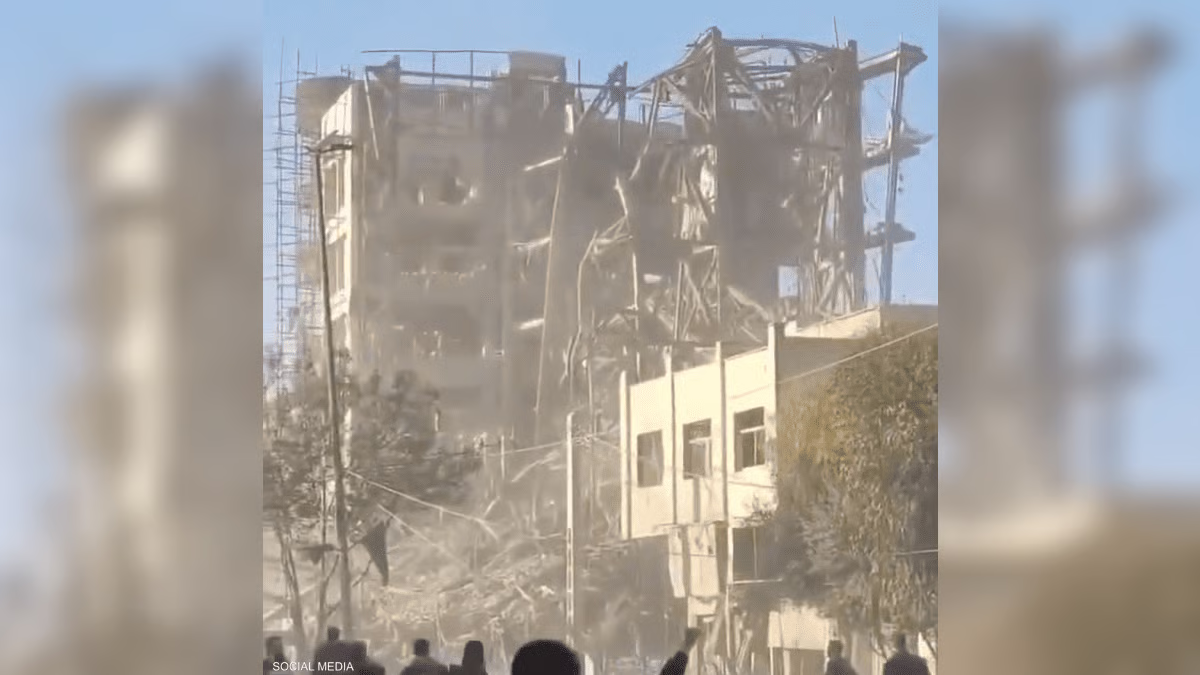
The strike that hit the Assembly of Experts building in Qom just hours ago wasn't just another military raid amid the escalating tensions. From my perspective, that very moment was the de facto declaration of one era ending and another, darker and more uncertain one beginning. As Israeli missiles rained down on the site, the assembled members—or those who remained—were on the verge of deciding the fate of the Islamic Republic's highest office. Leaks emerging from both Tehran and London all point in one direction: Mojtaba Khamenei, the late Supreme Leader's son, is the man the Revolutionary Guard has thrown its considerable weight behind to succeed his father.
The "Shadowy Hand" Comes to Light: Why Mojtaba?
I've been following the file on Mojtaba al-Shirazi (referring to his family lineage) for years, writing about him as the "man in the shadows" who runs his mother's economic empire and oversees the appointments of senior security chiefs. What happened in recent days came as no surprise to true observers of the Iranian scene. The surprise was the speed at which the cards were revealed. The moment Ali Khamenei was killed, the talk shifted from the "Assembly of Experts" as a constitutional body to an "Assembly Under Guard," where Meysam Motiei and other Guard insiders are the true kingmakers. The Revolutionary Guard knows that any candidate other than Mojtaba would open the door to an ideological battle over the revolution's foundations, while Mojtaba ensures the continuity of the "system" in the name of both religion and wealth.
The Qom Strike: A Desperate Attempt to Flip the Table?
The Israeli strike wasn't random; it was a precise targeting of the upcoming election process for Iran's next Supreme Leader. According to sources with knowledge of what was happening behind closed doors, the building in Qom was in the middle of vote counting or final consultations when the aircraft arrived. Tehran denied the main headquarters was targeted, calling it "old and auxiliary." But satellite imagery and video footage that reached our research team confirm the exact opposite.
Here's the crux of the matter: Why would Israel strike an electoral building if it were empty? And why would Tel Aviv proudly announce it disrupted the counting process? The answer is simple: because the timing of the succession represented the system's "Achilles' heel," and Israel tried to exploit that gap. But it seems Tehran was faster; the announcement of Mojtaba's selection came through immediate military and political pressure to preempt any chaos that Israel or even internal opposition, represented by the reformist Hashemi Khomeini faction, could exploit.
What Does the "Leader's Son" Taking Charge Mean?
If the news is confirmed in the coming hours—and I'd bet it's only a matter of time—Iran is entering an entirely new phase. The transfer of power from father to son transforms the system from "Velayat-e Faqih" (Guardianship of the Islamic Jurist) to "Velayat-e Family" (Guardianship of the Family). For me, this is a fundamental shift. It's no longer about the consensus of senior clerics, but about a security-military front run by a single family under a religious guise. Herein lies the major commercial and investment opportunity, so to speak, for the Gulf states, led by Saudi Arabia:
- Geopolitically: Greater Iranian intransigence on the nuclear file and negotiations with the West, meaning further regional escalation that could reshape energy alliances.
- Economically: The continued control of the "Mojtaba network" over vital sectors (from oil to contracting) means any thaw with Iran will be contingent on approval from this private network, not just the central government.
- On the security front: The Revolutionary Guard, which pushed Mojtaba forward, will become the undisputed paramount power, increasing the likelihood of indirect confrontations with Israel via proxies.
One of the most striking details was the leak from within Israeli decision-making circles immediately after the strike, which essentially said: "It doesn't matter who gets elected today; their fate is already sealed. Only the Iranian people will choose their next leader." This isn't just propaganda; it's an admission that Israel sees this succession as a chance to deepen the rift between the people and the regime. In response, I expect Tehran's reaction will be to accelerate its nuclear program as a bargaining chip and a source of domestic legitimacy.
The Bottom Line: Facing an Inherited "Republic of Fear"
In the end, it seems Mojtaba Khamenei will don his father's robe, but the burden will be heavier. The regional landscape is ablaze, Iran's economy is on the brink, and the people on the Persian street are exhausted. For us in the region, especially in Saudi Arabia, this means we'll be dealing with a more hardline, less flexible system, one that lacks even the traditional legitimacy his father once had. The Assembly of Experts election was over before it began, and all that's left is to watch how the "son" manages his father's legacy in a country groaning under the weight of sanctions and missiles.