Victor Orbán and right-wing populism’s march on Europe: What does his support mean for Denmark?
There’s something in the air at the moment. Maybe it’s the election campaign that’s about to sweep across Europe, but when you look at Budapest these days, it’s hard to ignore the symbolic weight. Victor Orbán is no longer just Hungary’s prime minister; he’s become a rallying point for an entire movement that stretches from Washington D.C. to Brussels. And it’s not just the usual European nationalists who’ve made their way to the Hungarian capital to show their support. No, if you look closer, this is about a much deeper alliance that calls into question the very foundation of our Western partnership.
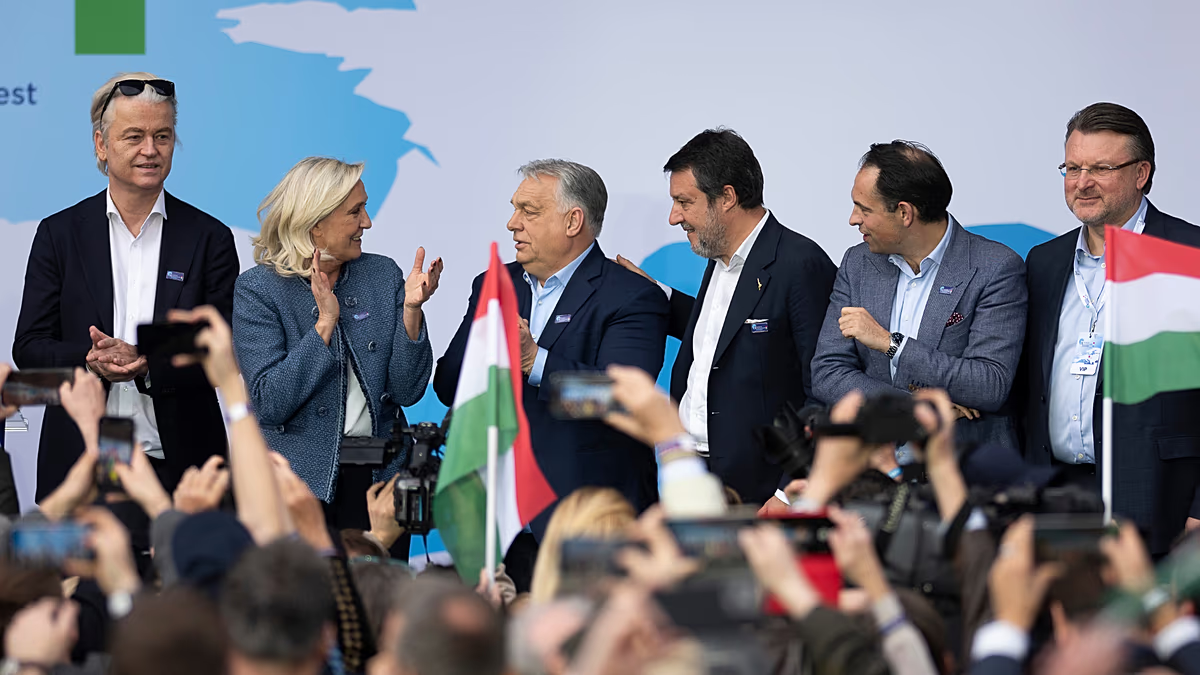
Budapest, the epicentre of power
We’ve seen it before, but never as clearly as right now. In recent days, the streets of Budapest have been filled with declarations of support, almost creating an alternative power hub within the EU. It’s not just the usual suspects from Poland or Italian ministers showing up. No, it’s the American connection in particular that’s really heating things up. You could call it the "America Last" movement, if you wanted to be a bit cheeky – a slogan that turns traditional US foreign policy on its head. Because that’s precisely what’s at stake here. While the majority in Washington has historically viewed Europe as a natural ally, a strong faction on the American right has emerged, one that has long had a soft spot for strongmen – from Putin to none other than Victor Orbán.
The long history of a romance
When you look into the dynamics, this is about much more than a few campaign posters. It’s about an ideological romance that’s been going on for decades. The American right has long had a strained relationship with the liberal world order that the US itself helped build after World War II. Instead, they’ve looked to leaders who speak their language: culture wars, sovereignty above all else, and a deep scepticism of what they call "globalism."
- The ideological kinship: It’s not just political tactics. There’s a genuine fascination with Orbán’s "illiberal democracy" – a model that’s gaining ground in several European countries.
- Trump’s open support: He’s made it a sport to meddle in European politics. He’s directly urged people to vote for Orbán, which is a pretty wild intervention in an ally’s internal affairs.
- The battle over values: For us here in Denmark, this is very much about which direction the EU should take. Should we have more of the Hungarian model, or should we stick to the principles of the rule of law?
This is where the concept of "Behind the Illiberal Turn: Values in Central Europe" really comes into its own. It’s not just about taxes or economics. It’s about what we define as our core values. Orbán has built a narrative around protecting Europe from outside forces, both physically and culturally. That narrative is selling like hotcakes among a growing group of voters – and not just in Hungary.
What does this mean for us in Denmark?
You might think this is all happening far away. But in reality, it’s as close as the next European elections. The forces that support Orbán have allies in our own parliament. The same arguments about sovereignty, about the "elite" in Brussels having seized power, keep cropping up. And with explicit backing from powerful forces in the US, it carries a whole different weight.
So we find ourselves in a situation where a decisive battle over Europe’s future is about to be fought. One side dreams of a strong, federal Europe based on liberal values. The other side, with Victor Orbán as its standard-bearer, dreams of a "Europe of homelands," where the nation-state has the final say, and they’re not shy about drawing inspiration from across the Atlantic. It’s going to be an intense election campaign, and it will undoubtedly shape the political agenda in Denmark far more than we might expect.