The Wizard of the Kremlin: Jude Law's Putin Sparks Debate – Here Are the First Reactions
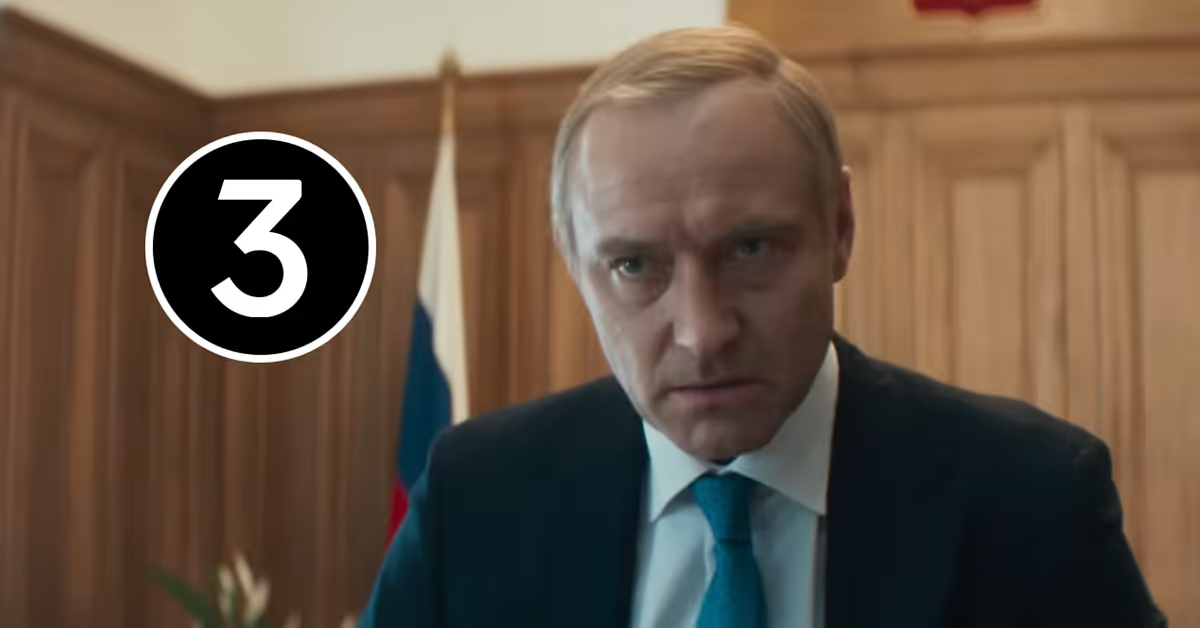
Few character interpretations have felt so charged in advance. When it was announced that Jude Law would step into Vladimir Putin's shoes for Olivier Assayas's The Wizard of the Kremlin, expectations were sky-high. Now, the first reviews from Swedish critics are in, and the picture that emerges is as complex as the main character himself. This is a film that refuses to offer easy answers, instead painting a portrait of a man hidden behind the thick walls of power.
We follow a fictionalised version of Putin, from his time as a relatively unknown bureaucrat in the corrupt St. Petersburg of the 90s, right up to his final emergence as the nation's strongman. Assayas, a master at depicting fragmented identities, weaves together historical events with an almost claustrophobic presence. It's far from a traditional biopic; rather, it's a surreal and, at times, terrifying journey into a mind shaped by paranoia and a lust for power.
A Wizard Without Tricks
Jude Law doesn't do an imitation. He doesn't capture Putin's gait or facial expressions in a carbon-copy way. Instead, he does something far more difficult – he captures the essence. With an icy calm and a gaze that can shift from empty to threatening in a heartbeat, he builds a figure who is both terrifying and, against all odds, occasionally pathetic. One of the country's most esteemed critics describes it as Law managing to be both comic and cruel, often within the same scene. It's a balancing act that could have failed, but here becomes the absolute core of the film.
What sticks with you isn't the grand political games, but the quiet moments. The scenes where we see him alone in a desolate bathroom, or when he watches his advisors with the same curiosity a snake has for a mouse. The direction lets us sense that the wizard's greatest trick might be convincing the world, and perhaps himself, that he is in complete control.
What Are the Critics Saying?
Swedish critics agree that this is a film to be taken seriously, although opinions on the final result vary somewhat. Here are the recurring themes in the reviews:
- Jude Law's Performance: Unanimously praised as something truly special. He carries the film on his shoulders and makes the character both fascinating and repulsive.
- Direction and Tone: Assayas blends satire, psychological drama, and political thriller with a steady hand. The result, however, according to some, is occasionally uneven.
- The Narrative Perspective: The film is loosely based on the controversial book of the same name and has sparked debate even before its release. Several critics note that it manages to be more nuanced than its source material.
- Overall Impression: Opinions differ here. According to one reviewer in public service media, it's called a "monotonous drama" that never really takes off, while others see it as one of the year's most urgent cinematic works. Another heavyweight critic highlights how it captures the absurd and ruthless mechanisms of Russian power.
Regardless of where one lands in their assessment, The Wizard of the Kremlin is a film that provokes and engages. It's a talking point that will live on long after the credits have rolled. For those of us fascinated by the psychology of power, this is a must-see on the big screen. It's rare to see a contemporary leader portrayed with such complexity, without being either glorified or simplified. It's a film for those who dare to meet the wizard's gaze.