David Amiel, the Government and the Revolt of Saint-Denis’s Municipal Police: A Political Powder Keg
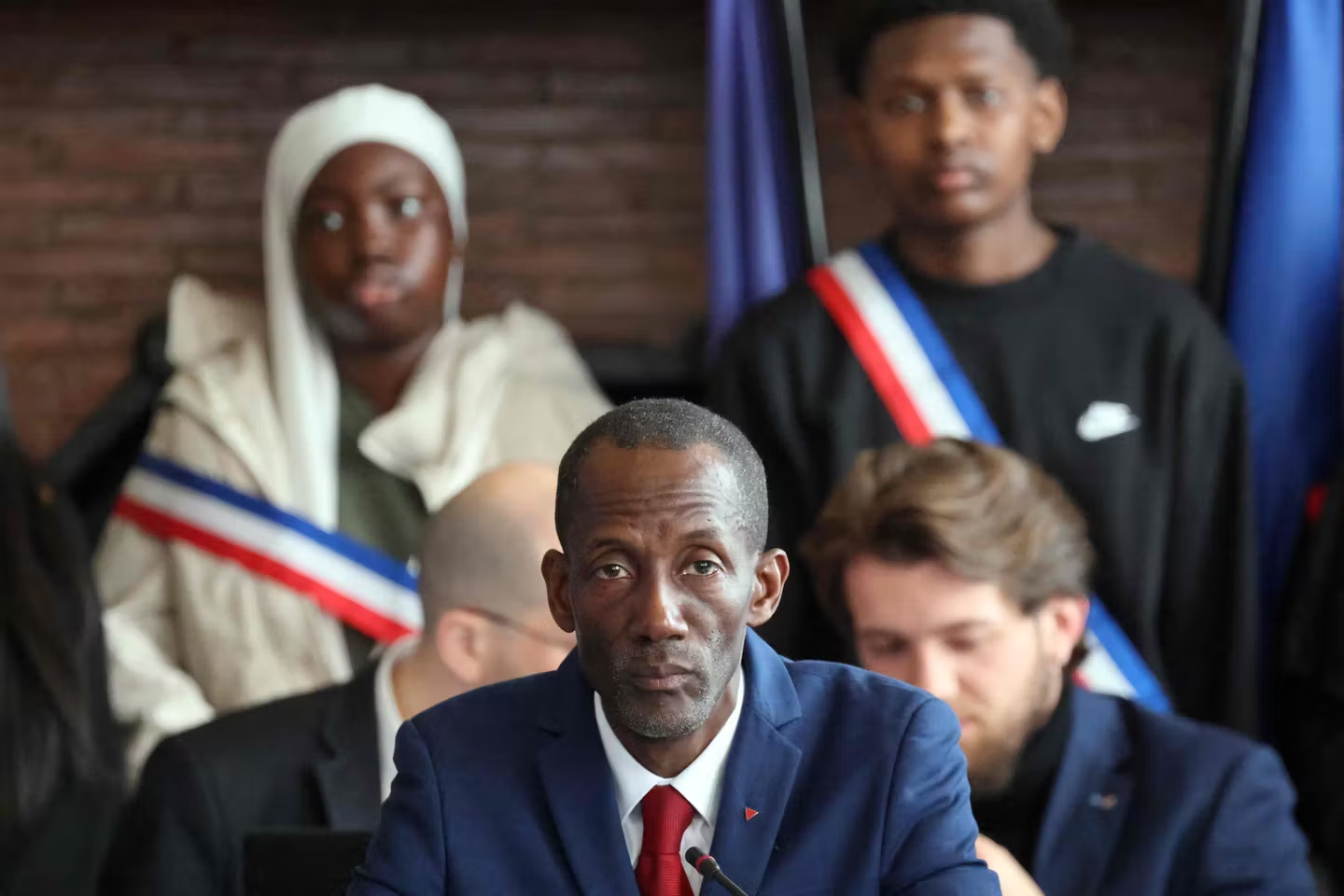
This is no longer a mere local squabble; it has become a full-blown political casus belli. For the past few days, the city of Saint-Denis has been at the epicentre of a storm that extends far beyond its borders, with everyone from the Interior Ministry to the corridors of the National Assembly watching intently as the rebellious mayor, Bally Bagayoko, plays a high-stakes game. Amid this backdrop of what feels like a regime on its last legs, one voice has been raised – that of David Amiel – to set the record straight. Among political observers, his intervention was instantly seen as a turning point.
A Disarmament Plan That Lit the Fuse
To understand the situation, we need to go back to the decision that sparked it all. The new LFI-led council, driven by a radical vision of public safety, announced its intention to disarm the municipal police. No half-measures here; the plan is to remove lethal weapons and replace them… with batons and crime prevention strategies. On paper, the argument is ideological: to de-escalate tension, to foster better relations. On the ground, however, the effect was like a sledgehammer blow. Within days, it wasn’t just a handful of dissenting voices, but 90 immediate requests to transfer. Ninety officers who feel they are being asked to do social work, not their job of protecting citizens.
We’ve seen similar situations in other towns, but a haemorrhage of this scale in such a short time is unprecedented. A deep institutional mistrust is taking hold. Officers aren’t resigning simply because they’re attached to their firearms; they are leaving because they believe the town hall is putting them in harm’s way. In this context, the unions were quick to sound the alarm. A call to "flee LFI-run towns" was issued, and the signal was heard far beyond Saint-Denis. Neighbouring towns, and even some right-wing councils, have positioned themselves as safe havens for these officers seeking stability.
David Amiel: The Executive’s Warning Shot
This is where David Amiel steps in. Known as a close ally of the government, a sharp mind often tasked with handling the most sensitive briefs to keep things running smoothly. But this time, his intervention had the effect of a match in a fuel depot. In a few short statements, he reframed the issue in legal, rather than purely ideological, terms. The argument is simple, but hits its mark: removing an officer for political reasons is strictly illegal.
This is not about a simple disagreement over patrol strategy. What the government’s circle is pointing to is a method that borders on a purge. By pushing through a disarmament that is perceived as an insult by the majority of the municipal police force, the town hall is creating a de facto situation where officers have "no choice but" to leave. It’s a classic power play, except here, the lever being used is a dangerous one. And David Amiel had the merit of highlighting this in the public eye, warning against what he considers a subversion of the civil service.
Reactions were swift. In the cafés along Rue de la République, just as in police stations, it’s the only topic of conversation. On one side, people defend the mayor’s right to implement his manifesto. On the other, there’s a belief that the government is right to remind everyone that public safety is not an ideological bargaining chip.
Lines Are Being Drawn, the Left Is Fracturing
What is fascinating about this saga is the domino effect on the national political landscape. While David Amiel has emerged with such firmness, we are witnessing a veritable exodus of municipal law enforcement. The right, lying in wait, is offering a "fraternal" welcome to officers who want to flee what they call "institutional insecurity." But the most interesting aspect is the silence – or rather, the murmurs – from within the left.
Because everyone knows that what is playing out in Saint-Denis could set a precedent. If disarmament and these implicit pressures are allowed to stand, what’s to stop other councils from doing the same? The government, through its advisers like David Amiel, has decided to draw a red line. For now, this remains at the level of political warning. But behind the scenes, I can assure you that legal experts at Matignon are working at full speed. The issue is far too sensitive to remain a mere war of press releases.
The list of immediate consequences from this crisis is long, and it will continue to demand our attention:
- Operational deficit: With 90 departures, the Saint-Denis municipal police force is drained. Patrols have been cut to an absolute minimum.
- Legal precedent: If this method is validated, it will be a severe blow to the local civil service.
- Ideological rearmament: The right is using this affair to hammer home its message on "national preference" in matters of security.
- Left-wing unity: LFI finds itself isolated, while socialist and green politicians prefer to keep their distance from this standoff.
The question remains how far this escalation will go. For now, Bally Bagayoko is holding his ground, playing the card of electoral legitimacy. But the pressure from David Amiel has at least succeeded in bringing the debate back to where it belongs: on legal grounds. Not on symbols, not on posturing. The law, stark and unyielding. And in this affair, that may be the only thing that can cool tempers before the situation truly spirals out of control. In the meantime, the coming days will be decisive. The unions are already calling for nationwide mobilisation of municipal police forces. If that happens, we’ll know that David Amiel’s warning was merely the first act of a much deeper conflict.