Boualem Sansal, a Goncourt Prize of Discord? Behind the Scenes of a Publishing Move That’s Shaking French Literature
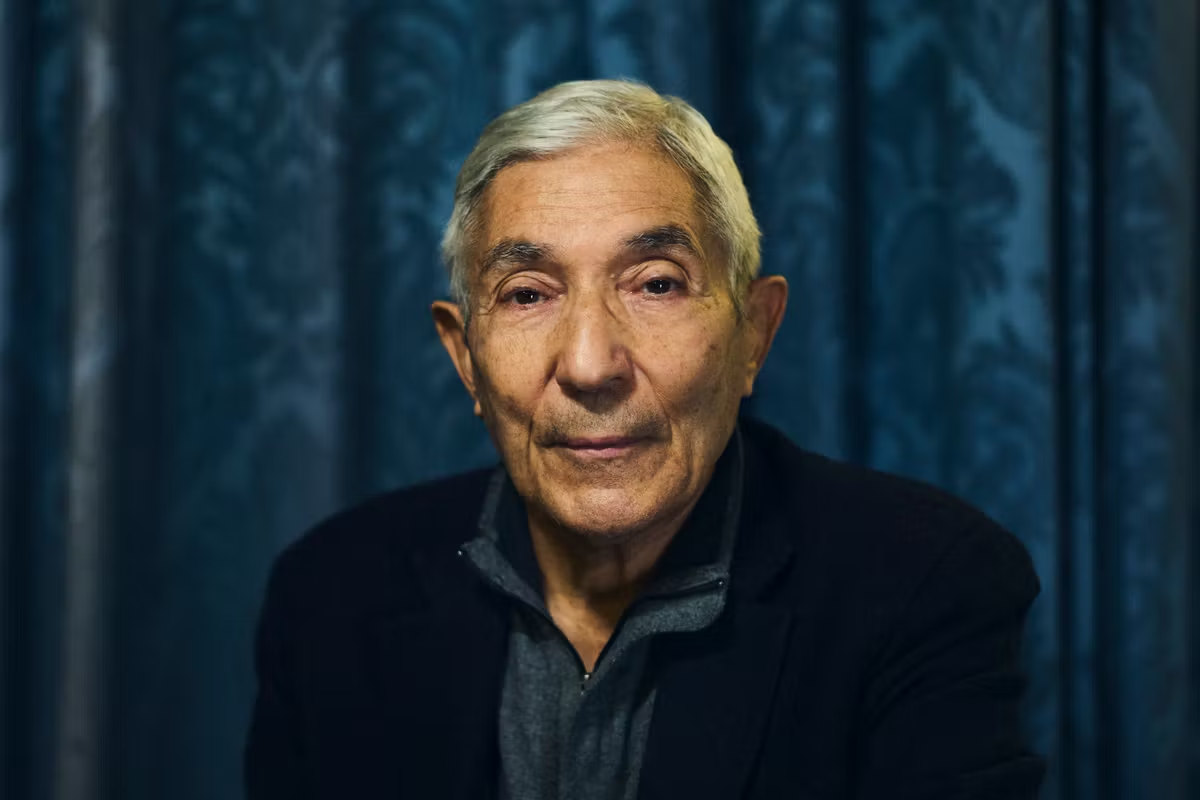
Just six months ago, Boualem Sansal was an icon. The Franco-Algerian writer, freshly released from an Algiers prison after a presidential pardon granted at the last minute in November 2025, was entering the hallowed halls of the Académie Française under the Coupole. The institution welcomed him with open arms. So did the Republic. But here’s the catch: this republican fairy tale has just taken a turn straight out of a Breton thriller. By leaving Gallimard for Grasset, Sansal has signed a transfer that reeks as much of gunpowder as it does of ink. And if you scratch the surface, you’ll quickly find the hand of Vincent Bolloré behind the whole affair.
The Defector of Discord: Why Sansal Is Slamming the Door on the House
The Parisian publishing world hasn’t seen such an earthquake in a long time. This spring of 2026 will be marked by a brutal announcement: Boualem Sansal, the quintessential dissident voice, is leaving his long-time publisher after twenty-seven years of loyalty. His destination: Grasset, a subsidiary of the Hachette Livre giant, which is owned by… the Bolloré empire. Officially, the 81-year-old writer speaks of a “strategic divergence” that arose during his detention in Algeria. Unofficially, tongues are wagging in literary salons and the corridors of rue Sébastien-Bottin.
In an op-ed published on March 17, Sansal explains himself without filters: “Antoine Gallimard favoured a diplomatic approach that I understand and respect. But it doesn’t align with the line of resistance I firmly embraced against the violent and cruel regime of Abdelmadjid Tebboune.” The writer regrets that his former publisher didn’t push harder, even if it meant he remained in prison. A radical, almost kamikaze stance. “No submission, no negotiation,” he repeats. Meanwhile, at Gallimard, they’re gritting their teeth. Behind the scenes, they recall that it was this very house that “moved heaven and earth” to get their author out of Algiers, even setting up a support association. The pill is bitter.
From Algeria to the Académie: The Troubled Rebirth of the “Algerian Orwell”
To understand the move, we need to go back a few months. Boualem Sansal, who became a French citizen in 2024, has never minced words with the Algerian regime. In November 2024, just after getting off the plane in Algiers, he was arrested. The reason? An interview given to a French magazine in which he challenged the borders inherited from colonisation. The verdict: five years in prison for “undermining national unity.” For a year, the writer paced his cell, ill, tired, but unbowed. Support committees formed in Paris. Gallimard carried out discreet back-channel efforts via lawyers and diplomats.
But in the end, it was Berlin that broke the deadlock. In November 2025, German President Frank-Walter Steinmeier obtained a humanitarian pardon for Sansal, who has prostate cancer. He was transferred to Germany, treated, and then returned to France bathed in a new prestige. In January 2026, he was elected to the Académie Française. Everything seemed scripted. Yet something is off. “I’m free in fact, but legally convicted,” he fumes. “And stripped of my Algerian nationality.” This “pardoned” status sticks in his throat. He wants to fight back. He wants to write a book of combat.
Bolloré’s Shadow: How Grasset Lured the Academician
This is where the story becomes less novelistic and more political. According to cross-checked behind-the-scenes information, it was former president Nicolas Sarkozy – a close associate of Vincent Bolloré – who whispered in Sansal’s ear that he’d be better off in the Breton billionaire’s stable. Sarkozy is said to have met with him in December 2025. Shortly after, Grasset offered him a jaw-dropping advance: industry insiders are talking about a one-million-euro contract – the kind of sum few “pure” writers dare to dream of.
Arnaud Lagardère, CEO of Hachette Livre, may argue that the author simply “wanted a professional change of scenery,” but everyone knows this transfer is highly political. Grasset, owned by Vincent Bolloré via the Louis Hachette group, has become a receptacle for a certain intellectual and media right wing. Think of certain heavily politically engaged media outlets, news channels, conservative weeklies – all those platforms that “did an enormous amount for his release,” as Lagardère himself points out, and that now expect to reap the rewards of their editorial investment.
The picture would be almost too simple if it weren’t full of contradictions. Here are a few things to keep in mind as you navigate this controversy:
- The former publisher (Gallimard): champions a diplomatic, discreet, “French-style” approach. It supported Sansal for 27 years but refuses to have its political line dictated to it.
- The new publisher (Grasset/Bolloré): offers a multiplied media springboard, a comfortable cheque, and above all, an unapologetic ideological echo chamber.
- The writer: sees himself as a misunderstood “resistance fighter.” He accuses his former camp of turning him into “bargaining chips.” Many others see this as sheer ingratitude.
Should We Boycott the Next Sansal? The Oddity of a Debate
So, how should we approach Boualem Sansal’s next book – the one he’s preparing on his “legend” and which will now come out with Grasset? Should we read it as an act of literary bravery or as the first product of a well-oiled ideological machine? Intellectual honesty requires us to separate the man from the institution. With and The German Mujahid, Sansal proved he is a powerful stylist, a chilling observer of totalitarianism. That talent doesn’t disappear under a lucrative contract.
But sadness prevails. Sadness to see a great writer, who could have embodied a certain demanding idea of freedom, become a banner in the culture war of the old men of the CAC 40. Is the Boualem Sansal guide that many were waiting for to understand Mediterranean rifts turning into a manual for recycling a dissident into a marketing product? The question deserves to be asked. In the meantime, bookstores are bracing for an explosive season. And we, the readers, are left with a dilemma: how to support free speech without endorsing the media circus of those who instrumentalise it?
The answer, as often, will be found in the pages. Provided the noise of the networks doesn’t permanently drown out the music of the words.