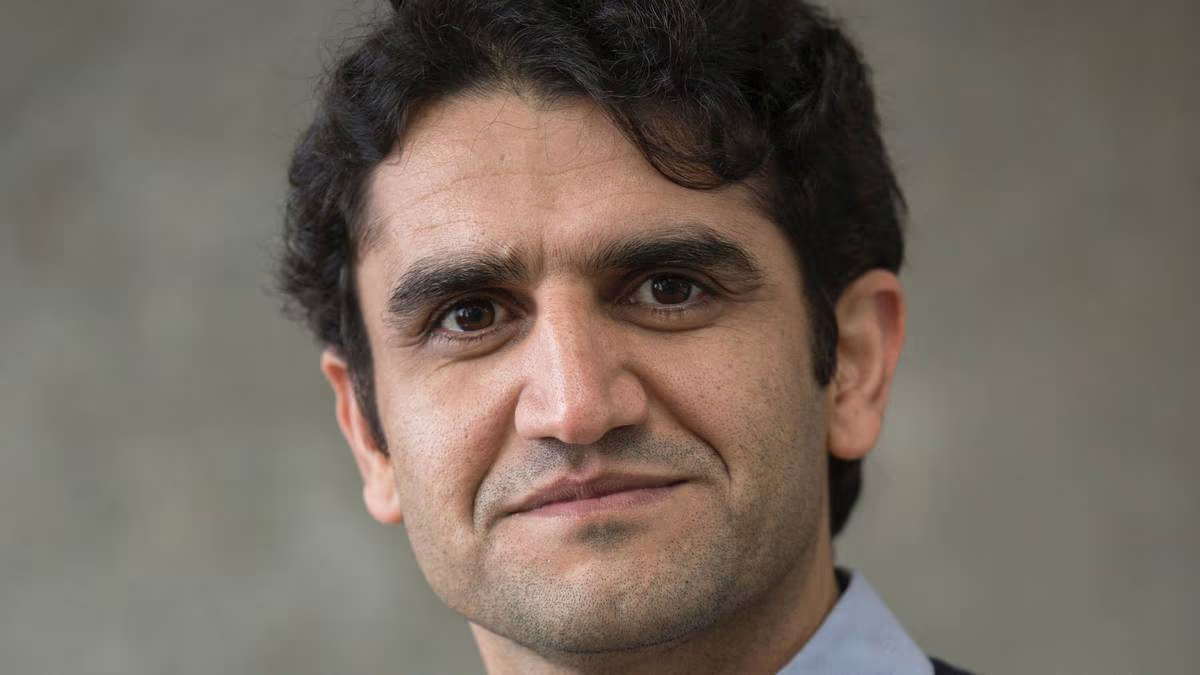
Hamid Amini (46) confirmed killed in Iran: – Norwegian interests in the crosshairs
It started with a name that appeared in internal messages. Hamid Amini. For most, it was just a name. For the employees at DNV, and for a family in mourning, he was a father, a colleague, a friend. Now, the 46-year-old has been confirmed killed in what is described as a coordinated attack in Iran. But this is far more than a tragedy striking a single individual. It's a wake-up call for the entire Norwegian establishment.
From business partner to target
While we've been following the name Hamid Aminikhah and its various spellings across different documents back home, the reality in the Middle East has taken a dramatic turn. What many might not have realized is that Norway is no casual bystander in this drama. We have significant interests in Iran. Just a few weeks ago, a massive deal worth 40 billion kroner was signed for the construction of solar parks in the Iranian desert. The company behind it? Norwegian Saga Energy, which partnered with Iranian actors. Behind the scenes, Norwegian diplomats were simultaneously working to open doors in oil, gas, and shipping.
It was a balancing act. An optimistic push for renewable energy and diplomatic engagement, while tensions simmered beneath the surface. Then came February 28th. The day Israel and the US managed to track down and kill Iran's supreme leader, Ali Khamenei, in a precision strike. The door Norway had so optimistically been knocking on was blown to pieces.
The retaliation that hit us
What happened next was neither surprising to someone who has followed the region for years, nor to the Iranians themselves. They had a plan. Before his death, Khamenei and his generals had laid out a strategy for a "regional escalation." The plan was clear: if the leadership was taken out, retaliation would be ruthless and far-reaching. The targets weren't just military, but also economic symbols. They aimed to hit Western interests hard, create fear, and pressure global markets to their knees.
And this is where Hamid Amini, or Hamid Amini Moghadam as he has also been referred to, came into the picture. Preliminary information from intelligence circles suggests he was in the city of Lamerd, a place not necessarily a military hub in itself. But in a time when anyone with a connection to the West is in the danger zone, even a "civilian" area can become a battlefield. DNV, one of Norway's most respected companies, has now lost one of its own. His Norwegian passport, which should have been a protection, was of little help when the rockets fell.
What does this mean for Norwegian businesses?
This is the big, uncomfortable question we now have to ask ourselves. The death of Hamid Amini moves the conflict from the geopolitical columns straight into the boardrooms of every Norwegian company with ambitions beyond Norway's borders. Suddenly, "risk" is no longer an abstract concept in a PowerPoint presentation. It has become deadly serious. Let's break it down:
- Employee safety: Suddenly, Norwegian citizens in the region are no longer "neutral." They can be seen as extensions of an enemy. Evacuation and security become the sole priority.
- Frozen billions: What happens to the 40 billion from the solar park deal? And all the other investments that were in the pipeline? They are essentially worthless as long as the conflict rages. Insurance companies will likely refuse to pay out for "acts of war."
- Reputation and ethics: Can a Norwegian company justify doing business in a country at war, where its own citizens are being killed?
A geopolitical earthquake with local aftershocks
It's easy to see this as just the beginning. The EU is holding emergency meetings, and the oil price is skyrocketing. For us in Norway, this means higher prices at the gas pump, but it also means something far more serious: It means we have to rethink our entire approach to international markets. We can no longer distinguish between "safe" and "unsafe" zones in the same way. When a Norwegian citizen, an engineer or a businessperson, can become a victim in a conflict they are not a part of, then the world has changed.
Hamid Amini is not just a statistic in a larger conflict. He is a symbol of the fragility that characterizes our time. A time where economic ties can become death sentences, and where Norwegian lives become the price of others' power plays. Our thoughts are with his family now. For Norwegian businesses, however, the time has come for a brutal awakening. The risk analyses need to be rewritten.