Macron's speech on nuclear deterrence: the great strategic turning point of 2026
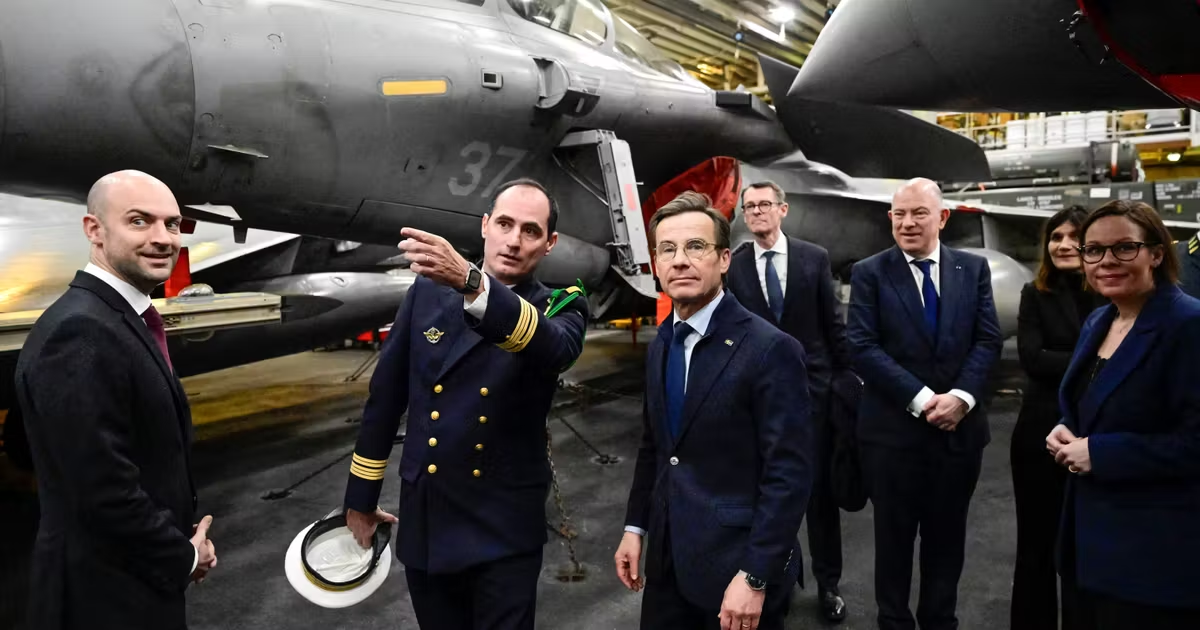
There are speeches that come and go, and those that mark history. The one Emmanuel Macron delivered this week from the site of the strategic oceanic force at Île Longue clearly belongs to the second category. By announcing an increase in the number of French nuclear warheads and detailing the outlines of the next generation of ballistic missile submarines, the head of state did not simply make a classic review of doctrine. He sent a clear signal to Paris, Berlin, Washington, and even Moscow: the world has changed, and France is adapting its deterrence accordingly.
For those who have been following these issues for twenty years, the Macron speech of February 2026 will remain as the birth certificate of a new era. Gone are the days when one could be satisfied with a simple posture. Today, it is about responding to multiple threats, and above all guaranteeing European strategic autonomy in a context where NATO itself is showing signs of fatigue.
The "world has changed": deciphering a revised and upgraded doctrine
The president was clear: "The world has changed." And to support this observation, the figures speak for themselves. The order has been given to increase the size of our nuclear arsenal. This is a break from the trend of unilateral reduction observed since the end of the Cold War. Insiders had seen this decision coming since discussions in restricted committee, but its formalisation in a Macron speech guide for the decades to come caught more than one analyst off guard.
Concretely, this build-up is accompanied by a colossal investment in infrastructure. The highlight of this new strategy is the launch of the first 3rd-generation SNLE (Nuclear-Powered Ballistic Missile Submarine). Christened "L'Invincible", this giant of the seas will be launched in 2036. It is a programme that engineers dream of and which, on an industrial level, guarantees decades of work for France's cutting-edge sectors.
The Scandinavian reaction: a "yes, but" that speaks volumes
In the immediate term, it is the international reactions that measure the shock. Take the case of the Scandinavian countries. Denmark and Sweden, often reserved on matters of "heavy" defence, have reacted with a mixture of approval and caution. This Nordic "yes, but" is a valuable indicator. They say yes to nuclear cooperation with France, because they know that, in the new European architecture, French deterrence is the only truly credible umbrella. But they are still hesitating on the conditions, on the framework. This is typical of their approach, but it especially shows that the Macron speech review is being carried out in real time in all European capitals.
For an investor or industrialist, the question is no longer whether France will invest, but rather how to use Macron's speech to anticipate tomorrow's markets. Here are the sectors that will boom in the next five to ten years:
- Military shipbuilding: The "L'Invincible" programme is just the tip of the iceberg. Frigates, underwater drones, everything will follow.
- Simulation and cybersecurity: A modernised deterrence also means thousands of lines of code to protect and simulators to train new generations of crews.
- Raw materials and precision subcontracting: The increase in the number of warheads implies a revival of the supply chain for critical materials.
The Trump effect and the European awakening: France as the ultimate bulwark
Let's not be mistaken. This speech did not come out of nowhere. It is the direct response to a deteriorating geopolitical context and chronic uncertainty from Washington. With the possibility of Donald Trump returning to the White House, Europeans, and the French in particular, know that they can no longer delegate their security. Macron understood this before others. By ordering this increase, he is not just protecting France; he is laying the foundations for a defence Europe that, to be credible, needs a nuclear pillar. And that pillar is us.
The figures are there. The "world has changed" is not a communication slogan; it is the reality of a continent that must now rely on its own strengths. The challenge for businesses, local authorities, and foreign partners is now to decipher this new situation. The Macron speech has opened a window; it is up to us to know how to use it to build the future.