Finnish Security and Intelligence Service expands recruitment – language skills and cooperation with Estonia's KAPO take centre stage
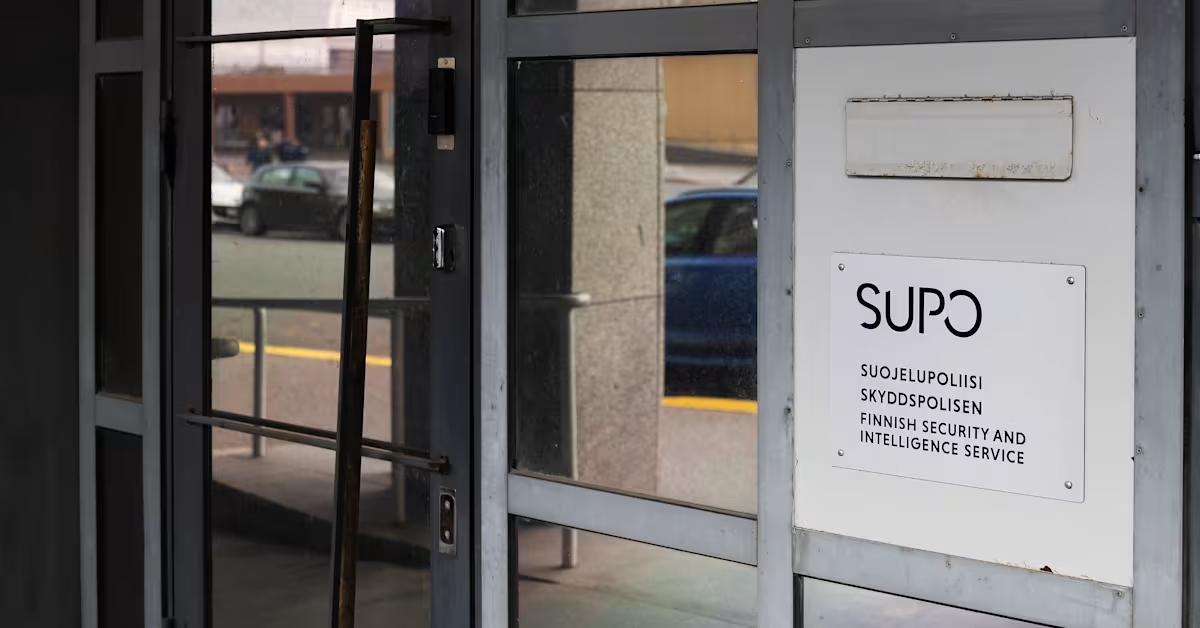
When the Finnish Security and Intelligence Service (known as Supo) recently put out a job advertisement looking for skilled people with language capabilities, it was no routine hiring round. It was a signal. For those of us who follow security policy, this is a clear sign that the playbook has been thrown out. The world is changing, and we have to change with it. In this piece, I'll dive into what Supo's new priorities mean, how they connect with the equivalent agency in our neighbouring country Estonia, the Kaitsepolitseiamet, and most importantly, what we should make of all this from a business and security perspective.
Why does Supo need language skills now?
The security environment just isn't what it was ten years ago. Hybrid influence, disinformation and cyber threats are part of everyday life. Traditional espionage has taken on new forms. In this world, the Finnish Security and Intelligence Service can no longer rely solely on traditional intelligence methods. It needs people who understand cultures, can read local social media channels and are able to analyse subtle signals. That's why the job advertisement highlights languages like Russian, Chinese, Arabic and certain Eastern European languages. This is a direct reflection of where the biggest threats are now coming from.
Supo's job isn't just to protect Finland from external threats. It's also about being proactive. Language skills provide a way to tap into precisely those conversations and networks that might be emerging. It's about prevention. We need to have our own eyes and ears where decisions are being made.
The connection with Estonia and the Kaitsepolitseiamet
It's interesting that at the same time Supo is strengthening its language skills, over in neighbouring Estonia, their own security police agency, the Kaitsepolitseiamet (KAPO), is doing the same. This is no coincidence. Finland and Estonia share the same geographical and geopolitical reality. We have a common adversary – or at least common challenges – in the Baltic Sea region.
Cooperation between Supo and the Kaitsepolitseiamet has intensified dramatically in recent years. It's no longer just polite information exchange at meetings. It's about operational partnership. Intelligence is shared in real-time, joint operations are planned, and personnel are cross-trained. This duo – Helsinki and Tallinn – is becoming the backbone of intelligence in the Baltic Sea region. And in this work, language skills are naturally key. The common working language is often English, but when you need to delve deep into Russian-language or, say, Chinese-language material, you specifically need that specialised expertise.
What does this mean for the security business?
All of this also has a clear commercial dimension. When state actors like the Finnish Security and Intelligence Service and the Kaitsepolitseiamet invest in specific areas, it creates demand in the private sector too. I'm talking about concrete business opportunities here:
- Language services and translation agencies: The need for high-quality, security-classified translations is growing. The so-called 'rare languages' are particularly in high demand right now. Companies that can offer not just technical translation but also cultural context are worth their weight in gold.
- Training and simulations: Both Supo and private operators (e.g., banks, critical infrastructure) need training that practises, for example, identifying disinformation or preparing for hybrid threats. This is a rapidly growing market.
- Technology and analytics: Processing and analysing large data sets requires new tools. AI-powered language analytics solutions that can sift through relevant information on, say, Russian-language forums, are hot property right now.
The Finnish Security and Intelligence Service's recruitment campaign isn't just an internal administrative matter. It's an indication of the direction the entire security sector is heading. Those who recognise this direction among the first will also be able to respond correctly in their own business operations.
In conclusion: The new normal
We have moved into an era where national security is in a constant state of flux. Supo is no longer that distant, grey agency that few knew anything about. It's a key player actively working to ensure Finland stays one step ahead. Cooperation with Estonia's Kaitsepolitseiamet is crucial in this. Their joint investment in language skills and new types of expertise is a direct response to the threats we all face. This development won't stop. On the contrary, it will accelerate. And that means authorities and businesses alike must be ready to invest in expertise, language skills, and cross-border cooperation – to guarantee not just tomorrow's security, but today's as well.