Dignity Beyond Death: Why the Bombay High Court’s Exhumation Order Is a Landmark Judgment
It isn’t every day that a court steps in to correct a wrong that occurred after a man had drawn his last breath. Yet, that’s precisely what a division bench of the Bombay High Court did last week, and in doing so, it didn’t just move a body—it shifted the very goalposts of how we understand the right to dignity in this country. The order, which directed the exhumation of a Muslim man’s remains from a Hindu cremation ground in Nagpur, is far more than a local dispute settled. It’s a masterclass in constitutional morality, and a stark reminder that the long arm of the law can reach even beyond the grave.
A Grave Error Corrected
Let’s rewind a bit. The case came before the Bombay High Court - Nagpur Bench after a devastating mix-up. A Muslim man passed away, and due to a combination of negligence and a complete breakdown in communication, his body was buried in a piece of land reserved for Hindu cremations. For his family, this wasn’t just a logistical nightmare; it was a profound violation of their faith and their final rites. They moved the court seeking not just compensation, but the physical transfer of the body to a designated Muslim burial ground. The state machinery, predictably, dragged its feet, citing bureaucratic hurdles and the “sensitivity” of disturbing a grave. But the judges on the Nagpur Bench saw it for what it was: a fundamental denial of dignity, even in death.
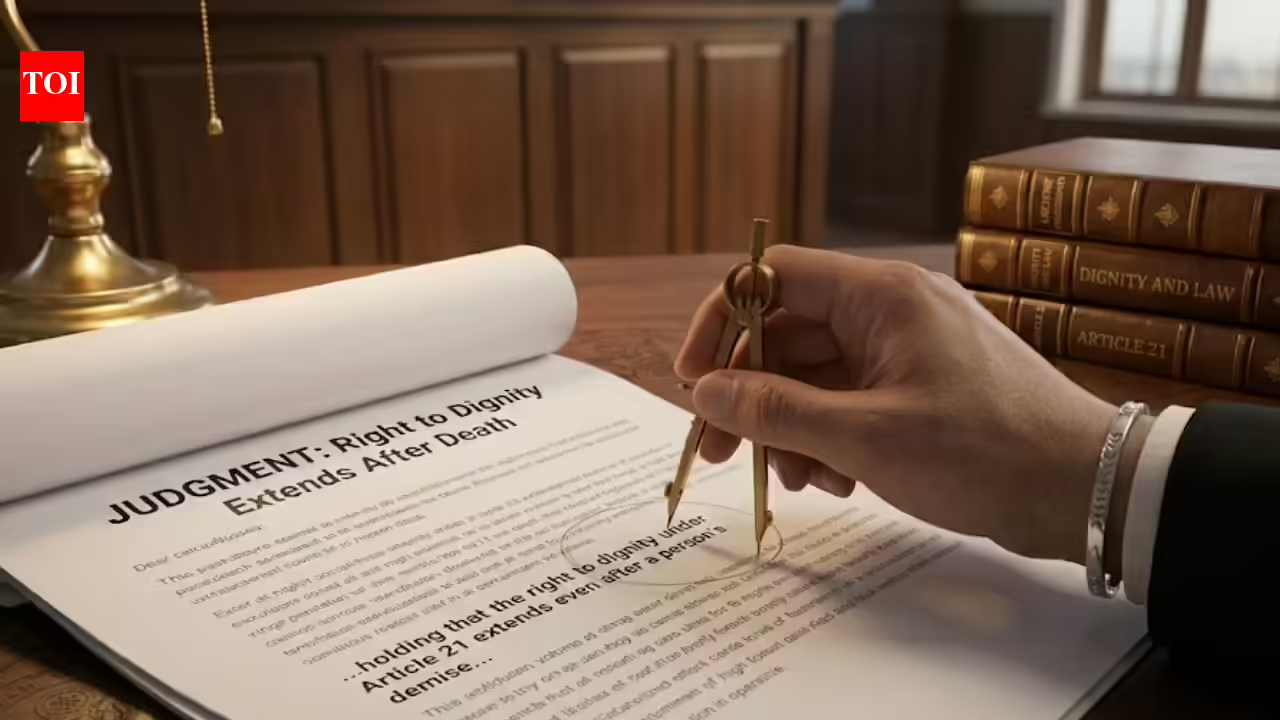
The HIGH COURT OF BOMBAY, in its wisdom, didn’t shy away from the practical complexities. It acknowledged that exhumation is never a pleasant affair, but it framed the issue squarely within Article 21 of the Constitution. The right to life, the bench observed, has long been interpreted to include the right to live with dignity. It was a small, logical leap to extend that protection to the deceased. If a person has the right to a dignified life, surely they have the right to a dignified departure and a resting place that honours their religious identity. The court ordered the exhumation and reburial within 48 hours, setting a timeline that forced the administration to act without further delay. This wasn’t just a judgment; it was a directive that carried the full weight of judicial urgency.
The Many Benches, One Conscience
What struck me, as I followed the proceedings, was how seamlessly the various arms of this institution operate. The initial petition was filed in Nagpur, but the principles it invoked are binding on every bench. Whether you are before the principal seat in Mumbai, the Aurangabad Bench - Bombay High Court, the High Court of Bombay at Goa, or the Bombay High Court - Kolhapur Circuit Bench, the interpretation of fundamental rights remains uniform. This particular order will now serve as a persuasive precedent across Maharashtra and Goa. Imagine a similar dispute arising in Kolhapur or Panaji; lawyers will inevitably cite this Nagpur ruling. It’s a beautiful illustration of how a single bench can speak for the entire institution, ensuring that the majesty of the law isn’t diluted by geography.
Beyond the Grave: Commercial and Social Ripples
Now, let’s talk about why this matters to you, whether you’re a developer, a community leader, or simply a citizen. This judgment opens a Pandora’s box of implications, particularly in the realm of property and land use. In a state where land is at a premium and religious sites often become flashpoints, the court has effectively declared that the intended religious character of a burial or cremation ground cannot be casually violated. For decades, we’ve seen encroachments, mix-ups, and even outright land grabs where community cemeteries or crematoria are concerned. This ruling sends a clear signal: if you bury someone in the wrong place, you may be forced to dig them up, no matter how much time has passed.
- For real estate developers: This is a wake-up call. Due diligence on land parcels must now include a rigorous check of historical burial and cremation practices. A project built on disputed sacred land could face catastrophic injunctions.
- For local municipalities: The order imposes a duty to maintain clear, accessible records of which land is designated for which community. Failure to do so will invite contempt proceedings.
- For religious bodies: It empowers them to assert their rights over traditional burial grounds with the backing of constitutional law, not just customary practice.
And it isn’t just about burials. The same logic could extend to places of worship, temples, churches, and dargahs. If a plot of land has a distinct religious character, any action that dilutes or disrespects that character could now be challenged far more aggressively. I’m already hearing whispers of multiple trusts consulting their legal teams, dusting off old land records, and preparing to approach various benches—from the High Court of Bombay at Goa to the Aurangabad Bench—to seek similar directions.
Quashing the Political: A Fortress of Accountability
Of course, the Bombay High Court’s recent activity hasn’t been limited to graveyards. In a completely separate but equally significant move, another bench recently quashed an order passed by the Minister of Cooperation. While the facts of that case were different, the underlying theme was identical: no one, not even a minister, is above the law. The court intervened to correct an arbitrary executive decision, reinforcing its role as the ultimate watchdog over administrative actions. This twin approach—protecting individual dignity while restraining executive overreach—is what makes the HIGH COURT OF BOMBAY one of the most vital institutions in western India. It isn’t just a forum for resolving disputes; it’s a bulwark against chaos.
The Bottom Line
For the common person, this ruling on exhumation might seem macabre or niche. But peel back the layers, and you’ll find it’s about something universal: the guarantee that your identity—and your final rest—will be respected. For businesses and communities, it’s a signal that the court will enforce that guarantee with an iron fist when necessary. The Bombay High Court, through its Nagpur, Aurangabad, Goa, and Kolhapur benches, has once again demonstrated that it is a living, breathing institution that adapts constitutional principles to the most human of problems. As we move forward, I suspect we’ll see a surge in litigation around religious land rights, and this judgment will be the cornerstone. The message is clear: dignity doesn’t end with death, and the court is watching over both the living and the departed.